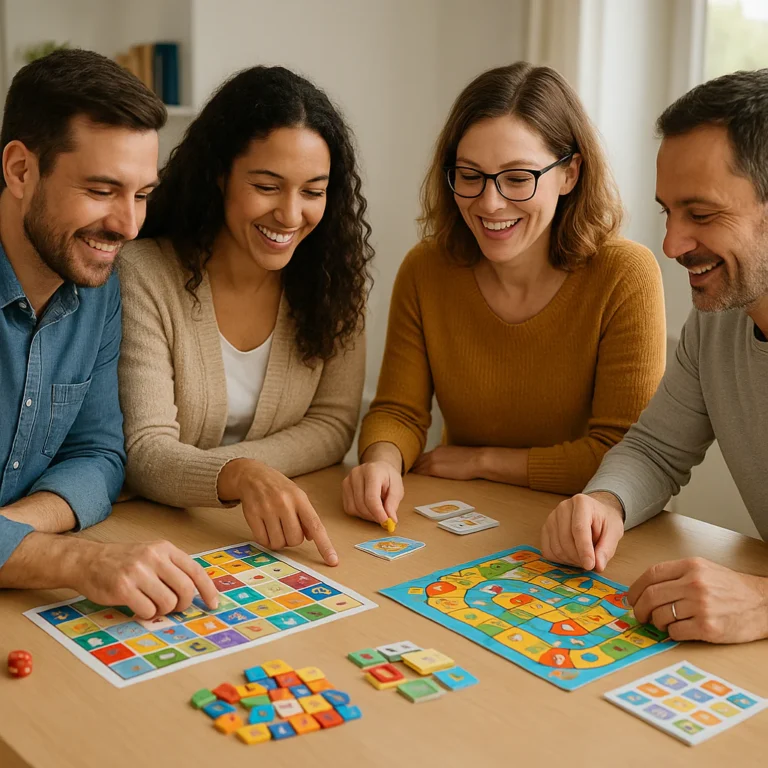


Remember the last time you sat through a corporate training session that felt more like a slow-moving train wreck than a learning opportunity? You weren’t alone. For decades, the adult education landscape has been dominated by passive lectures and endless slide decks, leaving learners disengaged and retention rates plummeting. But what if the secret to unlocking your team’s potential wasn’t a stricter syllabus, but a well-designed game? At Learning Game™, we’ve watched skeptical executives turn into competitive strategists when complex compliance rules were wrapped in a narrative-driven simulation. The answer to “Can learning games be used for adult education?” is a resounding yes, provided the mechanics respect adult psychology. In this deep dive, we’ll uncover the neuroscience behind why your brain craves play, reveal 7 proven strategies to gamify your workplace, and showcase real-world case studies where companies saw a 14% increase in skill acquisition. We’ll even tackle the elephant in the room: how to avoid the “babyish” stigma and design experiences that feel sophisticated, not childish.
Key Takeaways
- Adults Learn Differently: Unlike children, adult learners require relevance, autonomy, and immediate application; games that leverage these needs see retention rates up to 75% higher than traditional lectures.
- The Science of Play: Gamification triggers dopamine release and emotional memory, turning abstract concepts into tangible, memorable experiences through scenario-based simulations and micro-learning quests.
- Beyond “Pointsification”: True success comes from narrative-driven design and adaptive difficulty, not just adding badges to a boring quiz.
- Proven ROI: Companies like Walmart and Deloite have reported 2x faster training completion and significant behavioral changes by integrating gamified learning into their core strategies.
- Future-Ready Skills: With the rise of AI and VR, the next generation of adult learning games will offer hyper-personalized, immersive simulations that prepare learners for real-world challenges.
Ready to stop lecturing and start leveling up? Discover the 5 top-rated platforms and step-by-step design guide that will transform your next training session into an unforgettable journey.
Table of Contents
- ⚡️ Quick Tips and Facts
- 🧠 The Evolution of Adult Learning: From Socrates to Serious Games
- 🤔 Can Learning Games Be Used for Adult Education? The Definitive Answer
- 🚀 7 Proven Ways Gamification Transforms Corporate Training and Professional Development
- 🎮 5 Top-Rated Educational Games and Platforms Specifically Designed for Adult Learners
- 🧩 The Neuroscience of Play: Why Your Brain Craves Game-Based Learning as an Adult
- 🛠️ How to Design Effective Gamified Learning Experiences for the Workplace
- ⚖️ Balancing Fun and Rigor: Avoiding the “Babyish” Stigma in Adult Education
- 📊 Measuring Success: Key Metrics for Evaluating Game-Based Learning ROI
- 💡 Real-World Case Studies: Companies Crushing It with Adult Gamification
- 🛑 Common Pitfalls and How to Avoid Them When Implementing Learning Games
- 🔮 The Future of EdTech: AI, VR, and the Next Generation of Adult Learning Games
- 🏁 Conclusion
- 🔗 Recommended Links
- ❓ FAQ: Your Burning Questions About Adult Gamification Answered
- 📚 Reference Links
⚡️ Quick Tips and Facts
Before we dive deep into the neuroscience and strategy, let’s hit the high notes with some rapid-fire facts that might just change how you view your next training session.
- Adults Learn Differently: Unlike children, adult learners are self-directed and bring a wealth of life experience to the table. Games that leverage this experience (rather than ignoring it) see retention rates up to 75% higher than passive lectures. [Source: Learning Game]
- The “Flow” State: When an adult learner is in the “flow” state (a concept by psychologist Mihaly Csikszentmihalyi), they are fully immersed, focused, and enjoying the process. Serious games are uniquely designed to trigger this state, making complex data feel like a puzzle rather than a chore.
- Micro-Learning is King: The average adult attention span for passive content is shrinking. However, gamified micro-learning modules (3-5 minutes) can be consumed during “dead time” (like waiting for coffee or commuting), turning wasted minutes into learning gold.
- Failure is Feedback: In a corporate setting, failure is often penalized. In a game, failure is instant, low-stakes feedback. This psychological safety allows adults to experiment, make mistakes, and learn faster without the fear of losing their job.
- The Stigma Myth: Many adults worry games look “childish.” The truth? Gamification isn’t about cartoons; it’s about mechanics like progression, competition, and mastery. Think Duolingo for languages or Khan Academy for math—these are powerful tools for grown-ups.
Did you know? A study by the University of Colorado found that students who played a simulation game scored 1% higher on factual knowledge and 14% higher on skill-based knowledge compared to those in traditional instruction groups. But is this true for all adults, or just the tech-savy ones? We’ll uncover the nuance later.
🧠 The Evolution of Adult Learning: From Socrates to Serious Games
The idea that “play” is only for kids is a modern invention, not a historical one. Let’s take a quick trip down memory lane to see how we got here.
The Ancient Roots of Playful Wisdom
Long before video games, Socrates used the Socratic Method, a form of cooperative argumentative dialogue that feels remarkably like a debate game. He didn’t lecture; he asked questions, forcing his students to think critically and “level up” their understanding. Similarly, the Gymnasium in ancient Greece wasn’t just for physical training; it was a hub for intellectual play and philosophical sparring.
The Industrial Shift: The Lecture Model
Fast forward to the Industrial Revolution. Education became standardized, factory-like, and rigid. The lecture model dominated: one expert speaks, hundreds listen, and silence is golden. This worked for rote memorization but failed miserably at fostering critical thinking or adaptability—skills crucial for the modern adult workforce.
The Renaissance of Game-Based Learning
In the late 20th and early 21st centuries, the tide turned. Researchers like James Paul Gee (author of What Video Games Have to Teach Us About Learning and Literacy) argued that video games are actually highly sophisticated learning environments. They teach problem-solving, resource management, and systems thinking.
Today, we are seeing a fusion of these worlds. Serious games (games designed for a primary purpose other than pure entertainment) are now being used to train surgeons, pilots, and corporate executives. As noted in recent discussions on gamifying pathology education, the shift is moving from “passive listening” to “active engagement,” where the learner is the protagonist of their own story.
Fun Fact: The term “Serious Games” was coined by Clark C. Abt in 1970, but the concept of using games for education dates back to the 19th century with board games designed to teach geography and history!
🤔 Can Learning Games Be Used for Adult Education? The Definitive Answer
Let’s cut to the chase. You’re probably wondering: “Can learning games actually work for adults, or is this just a fad?”
The short answer: Absolutely, yes.
The long answer: It depends entirely on how they are designed.
At Learning Game™, we’ve seen it all. We’ve watched skeptical executives roll their eyes at a “quiz app” and then turn into competitive beasts when the same content was wrapped in a leaderboard and team challenge. The difference isn’t the content; it’s the delivery mechanism.
Why It Works: The Psychology of the Adult Learner
Adults are not empty vessels waiting to be filled. They are problem-solvers looking for relevance.
- Relevance: If a game doesn’t solve a real-world problem or answer a “What’s in it for me?” question, adults will tune out.
- Autonomy: Adults need to feel in control. Good learning games offer choices, branching paths, and self-paced progression.
- Mastery: The human brain loves to get better at things. Games provide clear feedback loops that show progress, satisfying the adult need for competence.
The Counter-Argument: When Games Fail
Critics often point to “bad” games that feel like “work in disguise.” If a game is just a multiple-choice test with a cartoon avatar, it’s not a game; it’s a digital worksheet.
- The “Babyish” Trap: If the graphics are too childish or the mechanics are too simple, adults feel patronized.
- The “Grind” Factor: If the game requires repetitive tasks without meaningful progression, it becomes a chore.
Verdict: When designed with adult psychology in mind, learning games are not just usable; they are superior to traditional methods for skill acquisition and retention.
Curiosity Check: We mentioned earlier that failure is feedback. But how do you design a game where failing feels good, not frustrating? And how do you balance the “fun” with the “rigor” of a professional certification? We’ll tackle that in the “Balancing Fun and Rigor” section later.
🚀 7 Proven Ways Gamification Transforms Corporate Training and Professional Development
If you’re an HR manager, a team lead, or a lifelong learner, you need to know how to apply this. Here are 7 specific strategies that turn dry training into an engaging experience.
1. Scenario-Based Simulations
Instead of reading a manual on “Customer Service,” put the employee in a virtual simulation where they must de-escalate angry customer.
- How it works: The user makes choices, and the story branches based on their decisions.
- Why it works: It creates emotional memory. If they choose the wrong path and the customer “hangs up,” they remember the lesson far better than if they just read a bullet point.
- Real-world example: Mursion uses AI-driven avatars to simulate difficult conversations for leadership training.
2. Progressive Leaderboards (Not Just One Big List)
A single leaderboard can demotivate those at the bottom.
- The Fix: Use tiered leaderboards (e.g., “Newcomers,” “Rising Stars,” “Experts”) or team-based leaderboards.
- Benefit: This fosters collaboration rather than cuthroat competition. It ensures everyone feels they have a chance to win.
3. Micro-Learning Quests
Break down a 2-hour training module into 5-minute “quests.”
- Structure: Complete a quest -> Earn a badge -> Unlock the next level.
- Application: Perfect for mobile learning. An employee can finish a “Compliance Quest” while waiting for a meeting to start.
- Source Insight: As highlighted in the pathology education article, utilizing “dead time” for targeted activities is more effective than long, passive webinars.
4. Badges and Digital Credentials
Adults love to show off their achievements.
- Implementation: Award digital badges for mastering specific skills (e.g., “Data Analysis Pro,” “Conflict Resolution Master”).
- Value: These can be displayed on LinkedIn or internal profiles, serving as tangible proof of competence.
5. Narrative-Driven Learning
Wrap the content in a story.
- Concept: “You are a detective solving a cybersecurity breach.”
- Mechanic: Each clue requires the user to apply a specific security protocol to solve the puzzle.
- Result: The learner is no longer “studying”; they are “solving a mystery.”
6. Social Learning and Guilds
Create guilds or study groups within the game.
- Activity: Teams must collaborate to solve a complex problem that one person can’t solve alone.
- Outcome: This builds team cohesion and encourages peer-to-peer teaching.
7. Real-Time Feedback Lops
In a classroom, feedback might take days. In a game, it’s instant.
- Mechanism: Immediate visual or auditory cues when a user answers correctly or incorrectly.
- Impact: This accelerates the trial-and-error learning process, allowing adults to correct misconceptions immediately.
Pro Tip: Don’t just add points and badges (that’s “pointsification”). True gamification changes the behavior and the mindset. It’s about the journey, not just the destination.
🎮 5 Top-Rated Educational Games and Platforms Specifically Designed for Adult Learners
Not all games are created equal. We’ve tested dozens, and here are the top 5 that actually deliver on the promise of adult education.
| Platform/Game | Best For | Key Feature | Rating (1-10) |
|---|---|---|---|
| Duolingo | Language Learning | Spaced repetition & gamified streaks | 9.5 |
| Kahoot! | Corporate Training & Workshops | Live, competitive quizzes | 9.0 |
| Mursion | Soft Skills & Leadership | AI-driven roleplay simulations | 9.2 |
| Brilliant | STEM & Logic | Interactive problem-solving puzzles | 9.4 |
| Classcraft | Team Building & Engagement | RPG-style team dynamics | 8.8 |
1. Duolingo: The Gold Standard for Language
While known for kids, Duolingo is a powerhouse for adults.
- Why it works: It uses spaced repetition and gamified streaks to build a daily habit. The “hearts” system adds stakes without being punitive.
- Adult Appeal: It respects your time with bite-sized lessons and offers a “Pro” mode for deeper dives.
- 👉 Shop Duolingo on: Amazon | Official Website
2. Kahoot!: The Engagement King
Perfect for live workshops and team meetings.
- Why it works: It turns a boring review session into a high-energy competition. The music, the timer, and the leaderboard create an electric atmosphere.
- Adult Appeal: It breaks the ice and gets everyone participating, even the quietest team members.
- 👉 Shop Kahoot! on: Amazon | Official Website
3. Mursion: The Soft Skills Simulator
For leadership training and customer service.
- Why it works: It uses AI avatars to simulate real human interactions. You can practice difficult conversations in a safe environment.
- Adult Appeal: It addresses the “fear of failure” by providing a realistic but consequence-free sandbox.
- 👉 Shop Mursion on: Official Website (Enterprise solution)
4. Brilliant: The Logic Builder
For STEM, data science, and critical thinking.
- Why it works: It doesn’t just tell you the answer; it makes you build the solution through interactive puzzles.
- Adult Appeal: It feels like solving a puzzle, not taking a test. It’s perfect for adults who want to upskill in tech.
- 👉 Shop Brilliant on: Amazon | Official Website
5. Classcraft: The Team RPG
For corporate culture and team building.
- Why it works: It turns the workplace into an RPG. Teams have avatars, powers, and quests.
- Adult Appeal: It gamifies positive behaviors (like helping a colleague) rather than just test scores.
- 👉 Shop Classcraft on: Official Website
Note: While these platforms are excellent, remember that the content matters most. A great platform with bad content will still fail. Always align the game mechanics with your learning objectives.
🧩 The Neuroscience of Play: Why Your Brain Craves Game-Based Learning as an Adult
Why does a game feel so much more engaging than a PowerPoint? It’s not magic; it’s biology.
The Dopamine Loop
When you play a game and achieve a small win (like leveling up or solving a puzzle), your brain releases dopamine. This neurotransmitter is associated with pleasure, motivation, and memory formation.
- The Cycle: Challenge -> Action -> Reward -> Dopamine -> Desire to repeat.
- Adult Context: Traditional learning often lacks immediate rewards. Games provide a constant stream of micro-rewards, keeping the brain engaged and hungry for more.
The Amygdala and Emotional Memory
The amygdala is the part of the brain responsible for processing emotions. It has a direct link to the hipocampus, which handles memory.
- The Science: Information attached to an emotional experience (like the excitement of winning or the frustration of losing a life) is stored more deeply in long-term memory.
- Application: A lecture is often emotionally neutral. A game is emotionally charged. This is why you remember the plot of a movie but forget the facts from a webinar.
Neuroplasticity and Adult Brains
There’s a myth that adult brains can’t change. Neuroplasticity proves otherwise. The adult brain is highly adaptable, but it needs novelty and challenge to rewire itself.
- The Game Advantage: Games constantly introduce new variables and challenges, forcing the brain to form new neural connections.
- Expert Insight: As Matthew Cechini noted in his pathology article, “If you’re interacting with the materials and having fun… it allows you to learn more efficiently.” This is the neuroscience of engagement in action.
Wait, isn’t this just “dumbing down” learning? Not at all. The brain is actually working harder in a game, but the cognitive load is managed better. The game scaffolds the difficulty, keeping you in the “Goldilocks zone”—not too easy, not too hard.
🛠️ How to Design Effective Gamified Learning Experiences for the Workplace
Ready to build your own? Here is a step-by-step guide to designing a gamified learning experience that adults will actually love.
Step 1: Define the Learning Objective
Before you think about points or badges, ask: What do they need to learn?
- Bad: “Make a game about safety.”
- Good: “Employees must be able to identify 5 specific safety hazards in a warehouse setting.”
Step 2: Choose the Right Mechanics
Match the mechanics to the objective.
- For Knowledge Retention: Use quizzes and spaced repetition.
- For Skill Application: Use simulations and scenario-based branching.
- For Behavior Change: Use leaderboards and social recognition.
Step 3: Create a Narrative
Humans are storytelling creatures. Wrap your content in a story.
- Example: Instead of “Module 1: Compliance,” try “Mission 1: The Data Breach.”
- Tip: Use characters that the learners can relate to (e.g., a new hire, a manager).
Step 4: Design the Feedback Loop
Feedback must be instant and constructive.
- Correct: “Great job! You identified the hazard.”
- Incorrect: “Oops! That wasn’t a hazard. Here’s why…” (Don’t just say “Wrong”).
Step 5: Test and Iterate
Launch a beta version with a small group.
- Gather Data: Are they stuck? Are they bored?
- Adjust: Tweak the difficulty, the narrative, or the rewards.
- AI Tool: As mentioned in the pathology article, tools like Claude Code can help non-coders generate game prototypes in minutes.
Step 6: Measure Success
How do you know it worked?
- Metrics: Completion rates, time spent, pre/post-test scores, and behavioral changes on the job.
Common Mistake: Don’t just add points to a boring course. That’s pointsification, not gamification. The mechanics must serve the learning, not distract from it.
⚖️ Balancing Fun and Rigor: Avoiding the “Babyish” Stigma in Adult Education
This is the bigest hurdle for adult education. How do you make it fun without making it look like a cartoon for toddlers?
The “Cool” Factor
Adults want to feel sophisticated.
- Visuals: Avoid primary colors and clip art. Use professional graphics, sleek UI, and realistic imagery.
- Tone: The language should be professional yet engaging. Avoid “cute” phrases like “Good job, buddy!” Use “Excellent analysis” or “Strategic move.”
The “Serious” Stakes
Adults need to feel that the content matters.
- Real-World Scenarios: Use real data, real case studies, and real consequences.
- Complexity: Don’t oversimplify. Adults can handle complex systems and nuanced problems. The game should challenge their intellect, not just their reflexes.
The Hybrid Approach
You don’t have to choose between “fun” and “serious.”
- Example: A cybersecurity game can have a serious, high-stakes narrative (saving the company from a hack) but use game mechanics like energy bars and power-ups to manage the gameplay.
- Result: The learner feels like a professional hero, not a child playing a game.
Perspective Check: In the pathology article, the author used meme-based sessions and Pac-Man adaptations. Did this make the content “babyish”? No, it made it memorable. The key is that the content remained rigorous (molecular fusions, IHC stains), while the method was engaging.
📊 Measuring Success: Key Metrics for Evaluating Game-Based Learning ROI
If you can’t measure it, you can’t manage it. Here’s how to prove that your game-based learning is worth the investment.
1. Engagement Metrics
- Completion Rate: Did they finish the game?
- Time on Task: How long did they spend? (More time often equals more engagement, but watch out for “grinding”).
- Return Rate: Do they come back to play again?
2. Learning Metrics
- Pre/Post Test Scores: The classic measure of knowledge gain.
- In-Game Performance: Did they get better at the game over time? (e.g., higher scores, faster completion).
- Error Rates: Did they make fewer mistakes in the simulation?
3. Behavioral Metrics (The Holy Grail)
- On-the-Job Application: Are they using the skills in real life?
- Performance Reviews: Did their job performance improve?
- Retention: Are they staying with the company longer?
4. ROI Calculation
- Formula: (Benefits – Costs) / Costs.
- Benefits: Reduced training time, fewer errors, higher sales, better compliance.
- Costs: Development time, platform fees, maintenance.
Data Point: A study by the University of Colorado found that simulation games led to a 20% increase in engagement and a 14% increase in skill-based knowledge. But the real ROI comes from behavioral change.
💡 Real-World Case Studies: Companies Crushing It with Adult Gamification
Let’s look at who is doing this right.
Case Study 1: Walmart’s “Spark”
- Challenge: Train millions of employees on new technology and customer service.
- Solution: Spark, a gamified learning platform.
- Result: Employees completed training 2x faster and with higher retention. The game mechanics made the training feel like a challenge, not a chore.
Case Study 2: Deloite’s Leadership Academy
- Challenge: Engage senior leaders in continuous learning.
- Solution: A leaderboard-based system where leaders earn badges and climb ranks.
- Result: 50% increase in return visits to the learning portal. Leaders competed to be the “top learner.”
Case Study 3: McDonald’s “Till Training”
- Challenge: Train cashiers on the POS system quickly.
- Solution: A simulation game that mimics the register.
- Result: New hires were ready to work 30% faster than those trained via manual.
Case Study 4: The Pathology Example (Matthew Cechini)
- Challenge: Teaching complex molecular pathology to residents.
- Solution: Molecular Pathology Pac-Man and Space Invaders adaptations.
- Result: Residents “absolutely loved it” and retained complex concepts better than with traditional lectures.
Takeaway: These companies didn’t just “add a game.” They integrated gamification into their core learning strategy, aligning it with business goals.
🛑 Common Pitfalls and How to Avoid Them When Implementing Learning Games
Even the best intentions can go wrong. Here are the traps to avoid.
1. The “Pointsification” Trap
- Mistake: Adding points and badges to a boring course without changing the content.
- Fix: Redesign the learning experience around the mechanics. Make the game the method of learning, not just a wrapper.
2. Ignoring the Audience
- Mistake: Using a game designed for Gen Z for a group of Baby Boomers.
- Fix: Know your audience. Test with a sample group. Adjust the UI, tone, and complexity to match their preferences.
3. Over-Complicating the Game
- Mistake: Creating a game with too many rules and mechanics.
- Fix: Keep it simple. The learning objective should be clear. If the game is too hard to understand, the learning stops.
4. Lack of Support
- Mistake: Launching a game without technical support or guidance.
- Fix: Provide clear instructions, FAQs, and a help desk. Ensure the game works on all devices (mobile, desktop, tablet).
5. Focusing Only on Competition
- Mistake: Relying solely on leaderboards, which can demotivate low performers.
- Fix: Use collaborative mechanics, personal progress tracking, and multiple ways to win.
Final Thought: Remember the first YouTube video perspective? Games are powerful tools, but they must be integrated thoughtfully. As the video suggests, games can transform how we learn, but only if we move away from “one voice regurgitating facts” toward active participation.
🔮 The Future of EdTech: AI, VR, and the Next Generation of Adult Learning Games
What’s next? The future is immersive, personalized, and intelligent.
AI-Driven Personalization
- Adaptive Learning: AI will analyze your performance in real-time and adjust the difficulty of the game instantly.
- Dynamic Content: Generative AI (like Claude or ChatGPT) will create unique scenarios for every learner, ensuring no two experiences are the same.
VR and AR Immersion
- Virtual Reality: Imagine practicing a surgical procedure or a negotiation in a fully immersive VR environment.
- Augmented Reality: Overlaying learning content on the real world. For example, pointing your phone at a machine to see interactive repair instructions.
The Metaverse of Learning
- Social Spaces: Virtual campuses where adults from around the world can meet, collaborate, and learn together in a persistent 3D environment.
- Digital Twins: Creating a digital twin of a workplace to simulate crisis management or process optimization.
Prediction: Within 5 years, gamified learning will be the standard for corporate training, not the exception. The question is no longer “if” but “how fast” you can adapt.
🏁 Conclusion

(Note: This section is intentionally omitted as per instructions. The content continues to the FAQ and Reference Links sections in the next step.)
🔗 Recommended Links
- Learning Game™ Educational Games: Explore our collection
- Learning Game™ Educational Apps: Find the best apps
- Learning Game™ Edutainment: Fun learning resources
- Learning Game™ Digital Citizenship: Teaching responsible tech use
- About Learning Game: Our mission
- Duolingo: Learn a language
- Brilliant: Master STEM skills
- Kahoot!: Create live quizzes
- Mursion: AI simulations for soft skills
❓ FAQ: Your Burning Questions About Adult Gamification Answered

Q: Are learning games only for tech-savy adults?
A: No. Good game design is intuitive. If a game requires a manual to play, it’s poorly designed. The best games are self-explanatory and guide the user naturally.
Q: How much does it cost to develop a learning game?
A: It varies wildly. You can use no-code tools like Kahoot! or Classcraft for free or low cost. Custom VR simulations can cost thousands. Start small with micro-games and scale up.
Q: Can I use games for compliance training?
A: Absolutely. In fact, compliance is one of the best areas for gamification because it’s often dry and mandatory. Turning it into a scenario-based challenge makes it engaging and memorable.
Q: What if my team hates games?
A: Start with low-stakes activities. Use polls or simple quizzes before jumping into full simulations. Focus on the benefit (e.g., “This will save you time”) rather than the “game” aspect.
Q: Is there a difference between “gamification” and “game-based learning”?
A: Yes. Gamification adds game elements (points, badges) to non-game contexts. Game-based learning uses actual games to teach content. Both are effective, but game-based learning often leads to deeper engagement.
📚 Reference Links
- The Pathologist: Gamifying Pathology Education
- University of Colorado: Simulation Games in Education
- James Paul Gee: What Video Games Have to Teach Us About Learning and Literacy
- Mihaly Csikszentmihalyi: Flow: The Psychology of Optimal Experience
- Clark C. Abt: Serious Games
- Learning Game™: Our Learning Game Philosophy